


Our Services
Construction-Ready Rail Design
Engineered to Carrier Standards
Via Rail Engineering PE-stamps every plan, because the right design upfront can save months of revisions later.
What Is Rail Engineering Design?
Rail engineering design is the technical foundation underneath every rail-served project. It’s the work that takes a feasible site and turns it into a railroad-approved, buildable facility. Once due diligence confirms a site can support rail, someone still has to determine exactly how: where the track goes, how it connects to the carrier’s existing line, how railcars get spotted and switched, and how the facility itself handles the commodity moving through it. Skip or rush this step, and a project can stall in railroad review, require costly redesigns, or get built in a way that never supports operations as intended.
Via Rail Engineering treats design as one connected discipline rather than a series of disconnected drawings, which is why our plans are developed with railroad approval, constructability, and long-term operations in mind from the start.

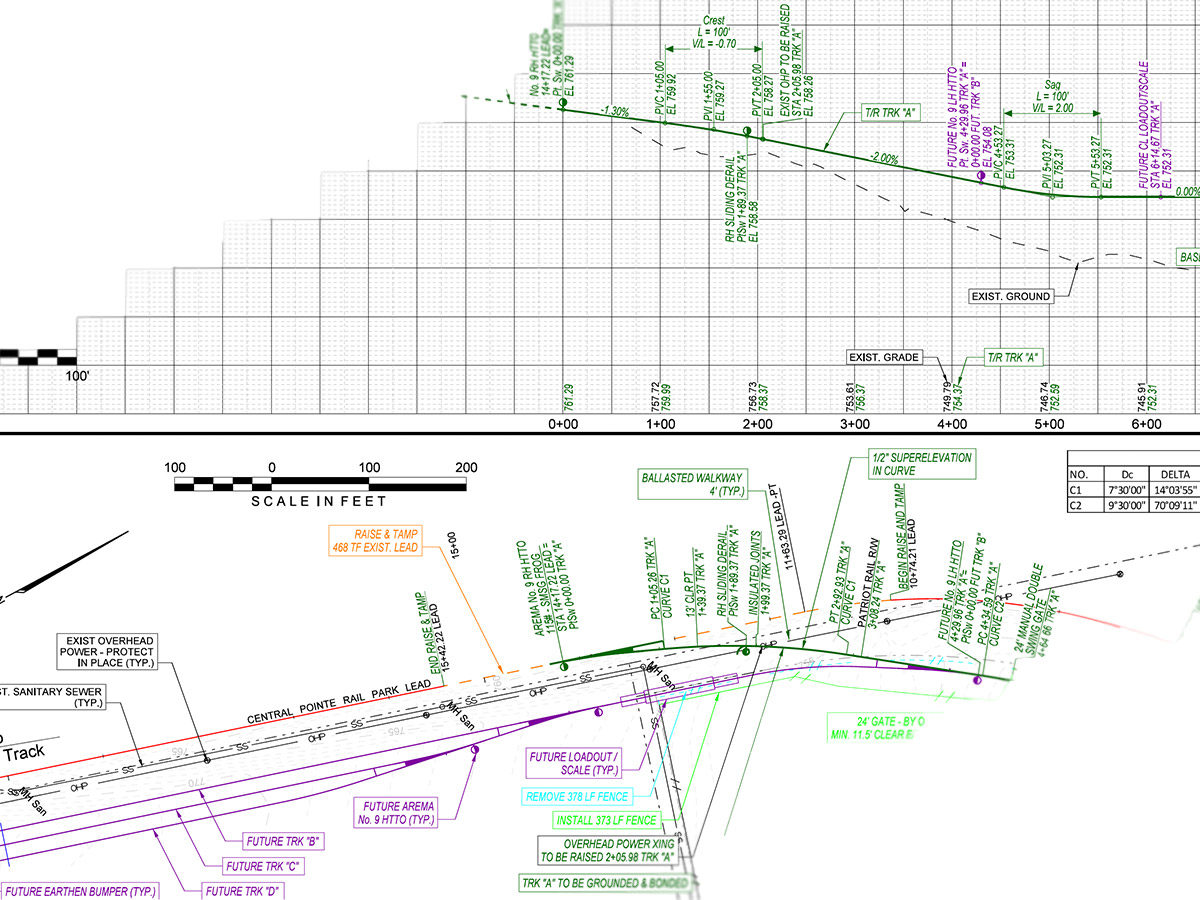
Rail Engineering Design
More Than a Drawing
A rail project can spend years in operation and decades in service. Decisions made during design affect railroad approvals, construction costs, switching efficiency, future expansion opportunities, and day-to-day operations long after the project is built.
That’s why Via Rail Engineering approaches rail design as more than a set of drawings. We design facilities that work for the railroad, the site, and the people who will use them every day.
Rail Engineering Services
Track Geometry and Alignment Design
Curves, Grades, and Clearances Engineered to Carrier Standards
Every rail line is defined by its geometry: how sharply it curves, how steeply it climbs or descends, how much clearance it leaves for passing equipment, and how a curve is banked, or superelevated, to keep cars stable at operating speed. These aren’t abstract numbers. A curve cut too tight or a grade left too steep can limit what equipment a railroad will allow on the line or create operational problems that only appear after construction. We design alignment to fit the site, the equipment that will use it, and the standards of the specific railroad that will operate it.
Yard and Siding Layout Design
Designed for Efficient Car Spotting, Switching, and Capacity
An industrial siding or yard has to do more than connect to the mainline; it has to work the way your facility actually operates. We design layouts around how cars will be spotted for loading and unloading, how a switch crew will move equipment through the yard without conflict, and how much capacity the facility needs today and may need later. A yard that looks fine on paper but forces awkward switching moves or limits the number of cars on-site at once becomes an operational headache long after construction is complete.
Industrial Rail Facility Design
Unloading Systems, Commodity Handling Infrastructure, and Specialty Rail Facilities
What happens at the railcar depends entirely on what’s moving through it and how the facility operates. We design the infrastructure that connects rail service to day-to-day operations, from unloading systems and commodity handling facilities to grain pits, car indexers, storage tracks, and specialized loading infrastructure. Whether the project serves manufacturing, agriculture, warehousing, chemicals, or bulk commodities, the goal is the same: create a facility where the track, equipment, and operations work together efficiently.
Complete Construction-Ready Plan Set Packages
From Initial Review Drawings to Final Construction Documents
Design isn’t finished until it’s buildable. We carry every project through staged plan sets, from Issued for Review (IFR) packages that go to the railroad and other stakeholders for comment, to final Issued for Construction (IFC) documents that incorporate that feedback and become the plans contractors build from. Coordinating that progression with the serving railroad’s review process is what keeps a project moving instead of getting stuck in revision cycles.
Railroad Standards Coordination Across Carriers
Every Railroad Has Different Rules and We Know Them
BNSF, Union Pacific, Canadian National, CPKC, Norfolk Southern, CSX, and major short lines each maintain their own engineering standards, and those standards do not always align. A design that satisfies one carrier’s clearance, turnout, or drainage requirements can still be rejected by another. We design to the standards of the railroad that will actually serve the site because that is the version of the plan that gets approved.
PE-Stamped Engineering on Every Plan
Every Deliverable Licensed, Sealed, and Ready for Approval
Every plan set Via Rail Engineering produces is reviewed and sealed by a licensed Professional Engineer before it leaves our office. That stamp is more than paperwork; it represents professional responsibility and confirms the design has been developed in accordance with applicable engineering standards. For railroads, permitting agencies, and project owners, a PE-stamped plan set is ready for review and approval.
Why Via Rail Engineering
Rail is the only thing we design for. We’re not a generalist civil firm that occasionally takes on rail projects, and our team includes professionals who have worked inside railroad organizations themselves. That experience gives us firsthand insight into how projects move through railroad review processes and what it takes to develop designs that meet operational, engineering, and approval requirements.
Every plan we issue is PE-stamped, and our experience spans BNSF, Union Pacific, Canadian National, CPKC, Norfolk Southern, CSX, Conrail Shared Assets, Wisconsin & Southern Railroad, and numerous short line carriers across North America.

NorthPoint Development Rail-Served Industrial Facility
Tyson Fresh Meats Rail Yard Expansion
Country Visions Cooperative Rail Expansion
Your Project Needs Rail
Let’s Design It Right the First Time
Whether you’re starting from a blank site or revisiting a design that didn’t get approved, we’ll build a plan set built to get through railroad review the first time.